

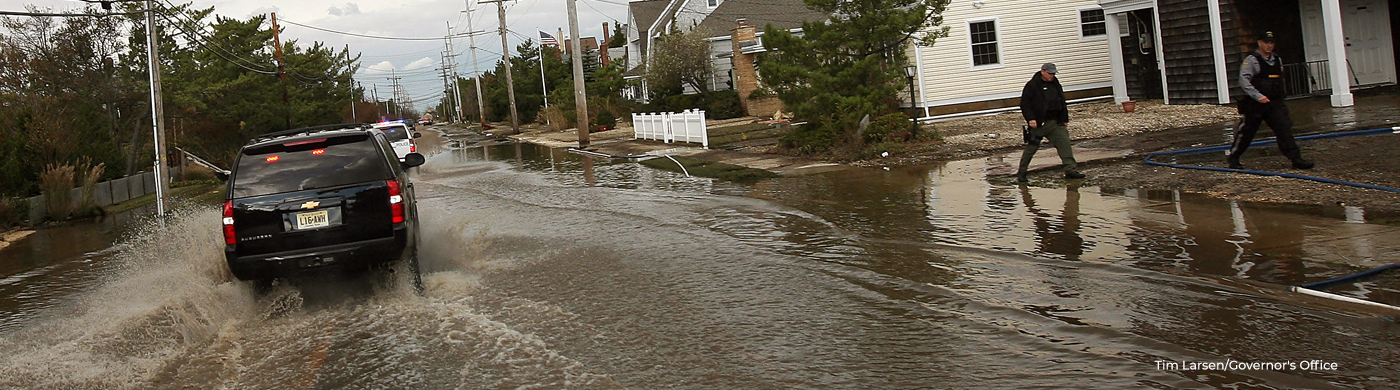
Street-Level Flood Hazard Analysis
 Lead: Sara Santamaria-Aguilar
Counselors: Thomas Wahl, Klaus Keller
Flood risk information is often derived from historic data and presented in a binary way, classifying areas as either ‘at risk’ or ‘not at risk’. This oversimplification fails to capture the complexity and gradations of flood hazards. Moreover, key flood drivers such as storm surges, rainfall, and river discharge are frequently assessed in isolation, even though most flood events result from the combined action of these drivers. It is also typically quite challenging to provide very localized, street-level flood risk information. This research project is conducting localized compound flood modeling analysis for future and current conditions for the MACH study sites, Gloucester City, NJ and Philadelphia, PA. To do this, the researchers will 1) develop high-resolution dynamical flood models for the MACH study sites; 2) perform probabilistic compound flood assessments for the MACH study sites under present and future conditions; 3) assess effects on resulting flooding from different combinations of drivers (including temporal and spatial variability) and model configurations; and 4) compare compound flood estimates with FEMA SFHA for MACH study sites. Ultimately, this project will deliver robust, high-resolution probabilistic flood hazard information that supports more informed adaptation and urban planning decisions. By conducting the modeling in close partnership with city stakeholders, the research ensures that the resulting data and analyses directly address local needs and enhance the capacity of Gloucester City and Philadelphia to plan for and manage future flood risks.
Products
Publications
Santamaria-Aguilar, S., Maduwantha, P., Enriquez, A. R., & Wahl, T. (2025). Large discrepancies between event-and response-based compound flood hazard estimates. EGUsphere [preprint], 1-25.
DOI: 10.5194/egusphere-2025-1938
Presentations
Santamaria-Aguilar, S., Maduwantha, P., Enriquez, A., Wahl, T. (2025) Large discrepancies between event- and response-based compound flood hazard estimates. American Geophysical Union Winter Meeting 2025. New Orleans, LA. https://agu.confex.com/agu/agu25/meetingapp.cgi/Paper/1856423
Video