

Power Systems Modeling: Regional Weather Impacts
 Lead: Siddiqur Rahman
Counselors: Thomas Wahl, Ning Lin
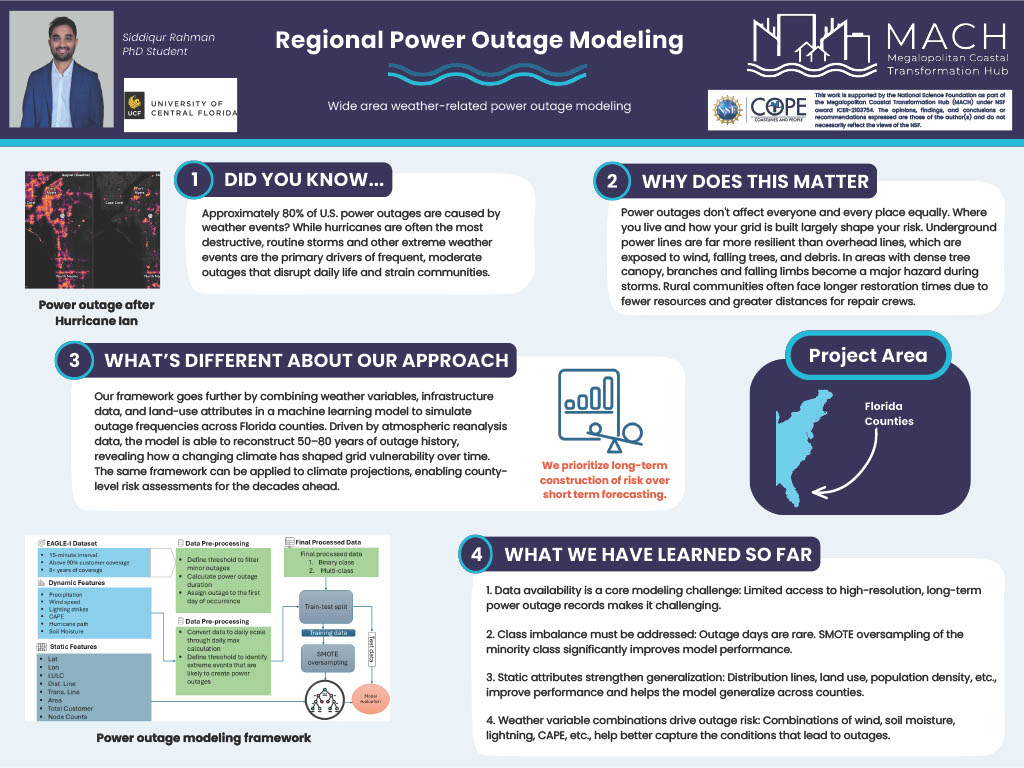
This research project, led by Siddiqur Rahman, models outage frequencies to help reveal how changes in climate over time have influenced power outages. Before engaging with MACH, Siddiqur developed a framework to examine how different weather factors, such as temperature, wind, and rainfall, both individually and in combination, have contributed to historic power outages across the state of Florida. His current work under MACH builds on this framework to model how often outages occur at the county level over the past 50 - 80 years. These estimates use extreme weather information along with other factors, such as transmission line length, population density, land cover, and land use.
Beyond understanding past impacts, the framework can use inputs from climate projections to predict how outage risks may change in the future if no major upgrades are made to the existing power grid. The framework is being expanded to understand these systems across the MACH region. This approach complements ongoing work in the Power System Modeling: Tropical Cyclone Impacts circle, which examines how hurricanes and heatwaves affect power grids. While research from other team members of this circle focuses on large-scale power outages, newly developed framework takes into consideration moderate power outage events on top of large power outage events that are big enough to make an impact on communities. Reconstruction of past and projection of future outages allow us to get a better understanding of power outages risk in a changing climate under the assumption of no major updates in power grid.
Products
MACH Annual Meeting Poster
 (opens in a new tab)