

Barrier Island and Habitat Modeling for Conservation Management
 Lead: Eric Dammann
Counselors: Jorge Lorenzo-Trueba, Klaus Keller
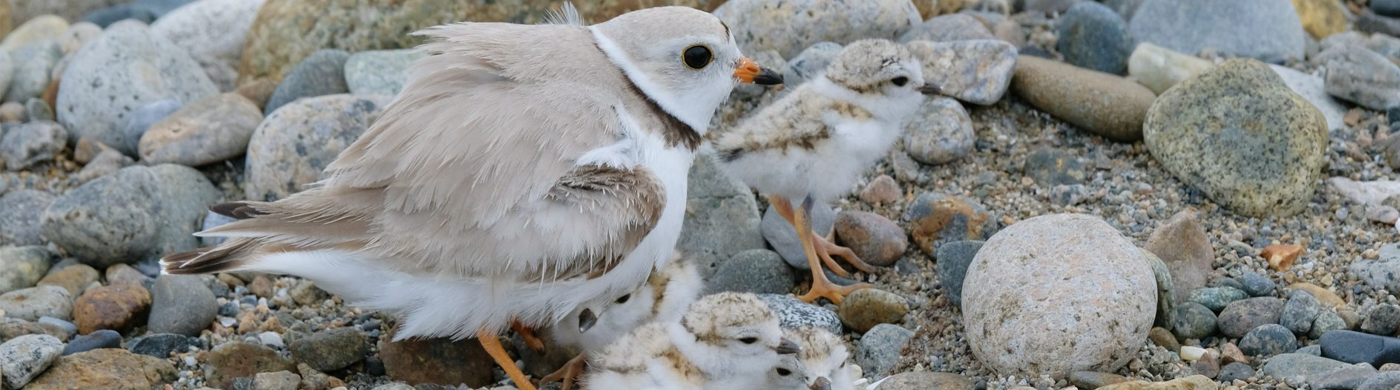
In collaboration with the U.S. Fish and Wildlife Service (USFWS), MACH researchers are assessing how the shape and structure of barrier islands, often altered by sea-level rise, storms, and coastal engineering, affect shorebird habitat, especially for the piping plover. The piping plover is of specific interest because it is listed as a federally threatened species and depends on dynamic coastal habitats that are particularly vulnerable to change. This collaborative research effort aims to support adaptive conservation and management strategies that balance ecological function with coastal protection along the coast of New Jersey. Eric Dammann is leading the development of a numerical model that links barrier island change with habitat suitability metrics. This model enables researchers to project how future changes under different coastal management scenarios—such as dune construction, beach nourishment, or marsh restoration—may influence the availability and quality of the piping plover's nesting habitat over time. To further enhance this model, this project is done in collaboration with MACH research on Berm Dune Monitoring, where researchers are using drone surveys to quantify the role of vegetation cover on berm-dune geometry and sedimentation patterns in Long Branch, NJ. Together, these efforts support USFWS and other stakeholders in making informed decisions about habitat conservation, land acquisition, and long-term coastal adaptation.
Products
Presentations
Dammann, E., Lorenzo-Trueba, J., Pollack, A., Helgeson, C., Keller, K. (2025). A Co-Developed Morphodynamic Model to Support Piping Plover Conservation Management. American Geophysical Union Winter Meeting 2025. New Orleans, LA.
https://agu.confex.com/agu/agu25/meetingapp.cgi/Paper/1872655