

Regional Impacts of Beach Nourishment
 Lead: Owen Thomas
Counselors: Jorge Lorenzo-Trueba
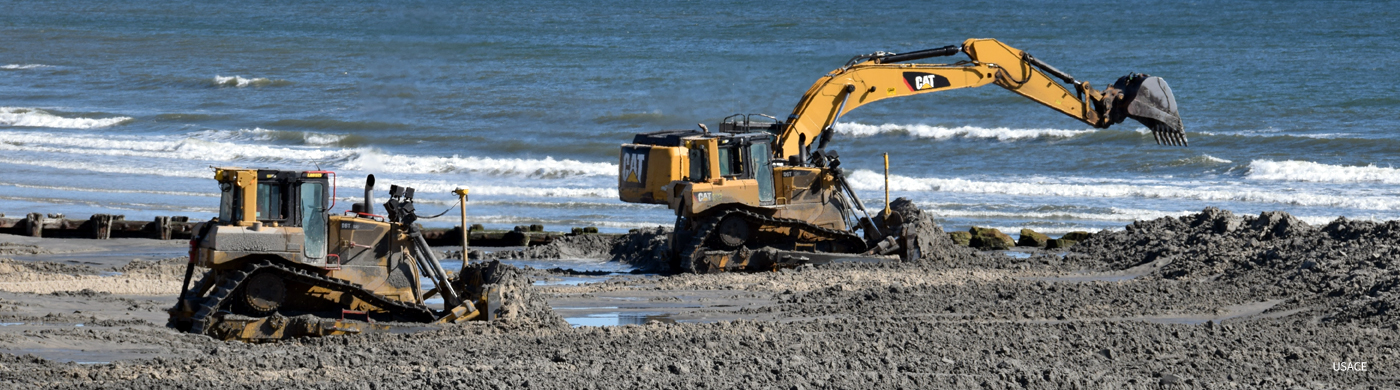
One common coastal management practice, beach nourishment, is the act of adding new sand to a shoreline to replenish sand that has been swept away due to erosion. MACH-affiliated researcher, Owen Thomas, builds on prior MACH-supported modeling to investigate the degree to which coordination among neighboring coastal towns affects the long-term sustainability and cost-effectiveness of shoreline management, specifically beach nourishment practices, under different sea-level rise and storm scenarios. By coupling physical models of coastal change with socio-economic drivers such as tourism dependency, the work aims to identify the emergent patterns of adaptation that arise from shared sediment systems and regional policy choices. Preliminary results show that when towns coordinate their nourishment decisions, they collectively maintain wider beaches for longer and reduce overall costs, whereas uncoordinated strategies can unintentionally accelerate erosion in neighboring communities. This work highlights the importance of regional planning for sustaining coastal economies and adapting effectively to future sea-level rise.
This project is led by a MACH research affiliate who does not receive direct financial support from NSF award ICER-2103754.
Products
Publications
Lorenzo-Trueba, J., Janoff, A., Thomas, O., Jin, P., Hoagland, P., & Ashton, A. (2025). From Coastal Retreat to Seaward Growth: Emergent Behaviors from Paired Community Beach Nourishment Choices. Earth’s Future, 13(8), e2025EF006352.
DOI: 10.1029/2025EF006352
Presentations
Lorenzo-Trueba, J., Janoff, A., Thomas, O., Jin, D., Ashton, A., Hoagland, P. (2025). From Coastal Retreat to Seaward Growth: Emergent Behaviors from Paired Community Beach Nourishment Choices [Poster]. American Geophysical Union Winter Meeting 2025. New Orleans, LA.
https://agu.confex.com/agu/agu25/meetingapp.cgi/Paper/1900379