

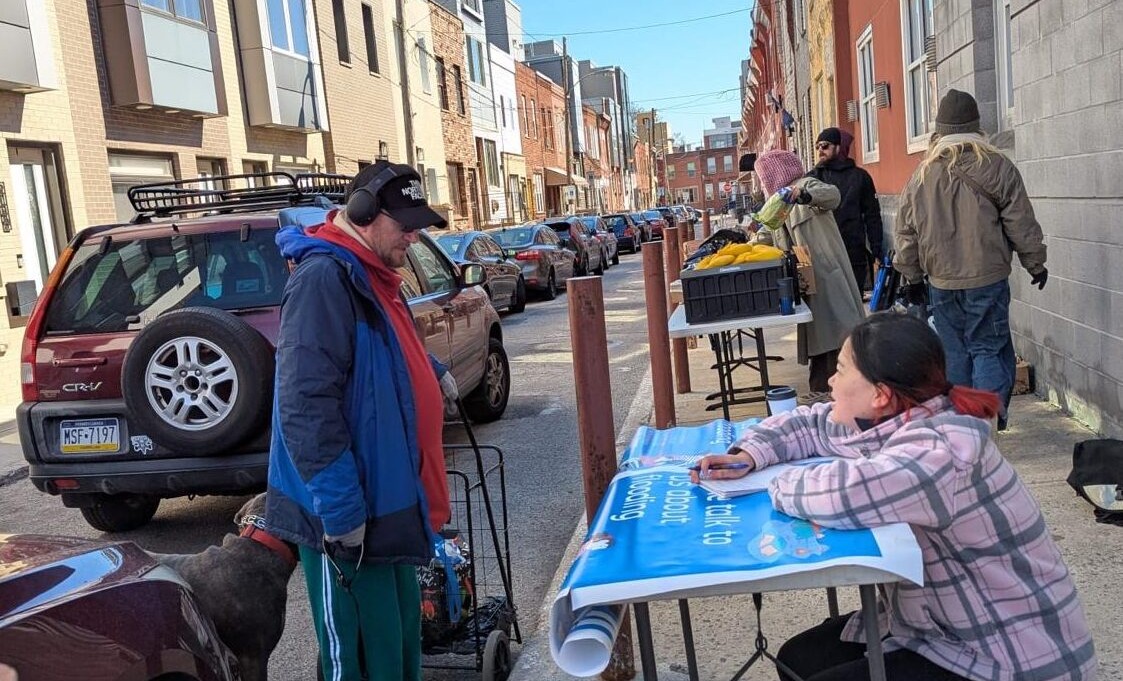
Amy Li, Rutgers doctoral student in the Student, Human Evolutionary Sciences in the Department of Anthropology, chats with community members while participating in a Homies Helping Homies distribution event in Philadelphia, PA.
While equity in climate adaptation is increasingly recognized, university-based research can inadvertently reinforce inequities. Inequities often arise when research fails to engage communities, overlooks relevant concerns, lacks trust, or misinterprets responses due to insufficient cultural understanding. Mutual aid organizations, inherently community-based, foster resilience and solidarity, addressing unmet needs while building collective trust.
A new article, co-authored by Rutgers researchers and other university colleagues [members of MACH’s Household Decision Making team] and Philadelphia-based mutual-aid group, Homies Helping Homies (HHH), examines how a research partnership can fundamentally reshape climate adaptation research practices by shifting the focus from traditional, top-down academic approaches to equitable, action-oriented, and community-engaged co-production of knowledge.
The article, From Transactional to Transformative: Evolving Research Practices Through Mutual Aid Collaboration, shows that such a transformation prioritizes the needs and expertise of vulnerable communities, making research outcomes more relevant and implementable, according to the study.
Read the full article in SEBS/NJAES Newsroom.